2025
Robotic Installation (Industrial Manipulator, Humanoid Agent),
Real-time Simulation, Orbital Debris Data
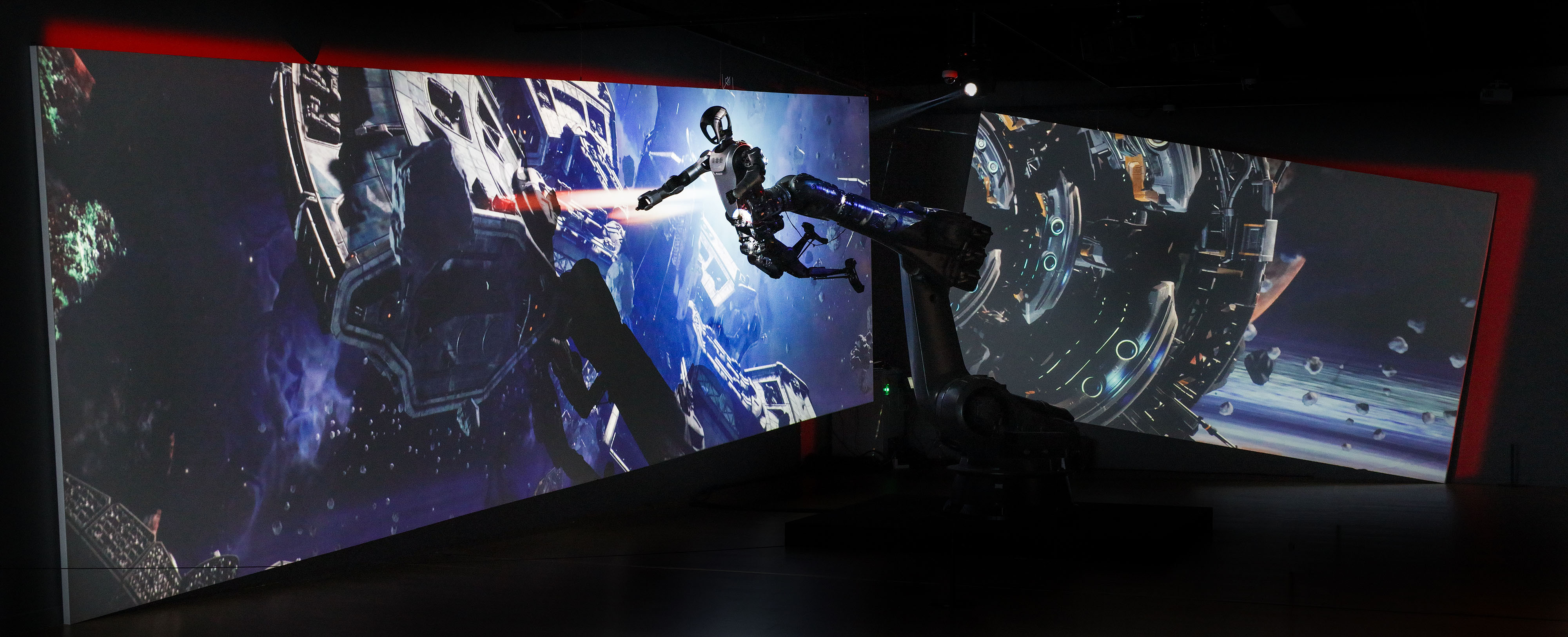
Stardust Yu Gong critiques the "innovation delusion" of constant novelty. By binding technical capacity to inheritable obligation, it asks: How do we design systems that survive political cycles and technological obsolescence? The work transforms the robot from a machine of simple labor into a vessel for intergenerational care, arguing that to survive the deep future, we must design for lineage rather than ownership.
Concept: The Steward Regime
Stardust Yu Gong is a robotic art installation that reimagines our relationship with deep-time hazards, specifically the accumulation of orbital debris. It proposes a shift away from traditional robotic roles—the obedient Slave, the detached Judge, or the charming Butler—toward a new modality: the Steward.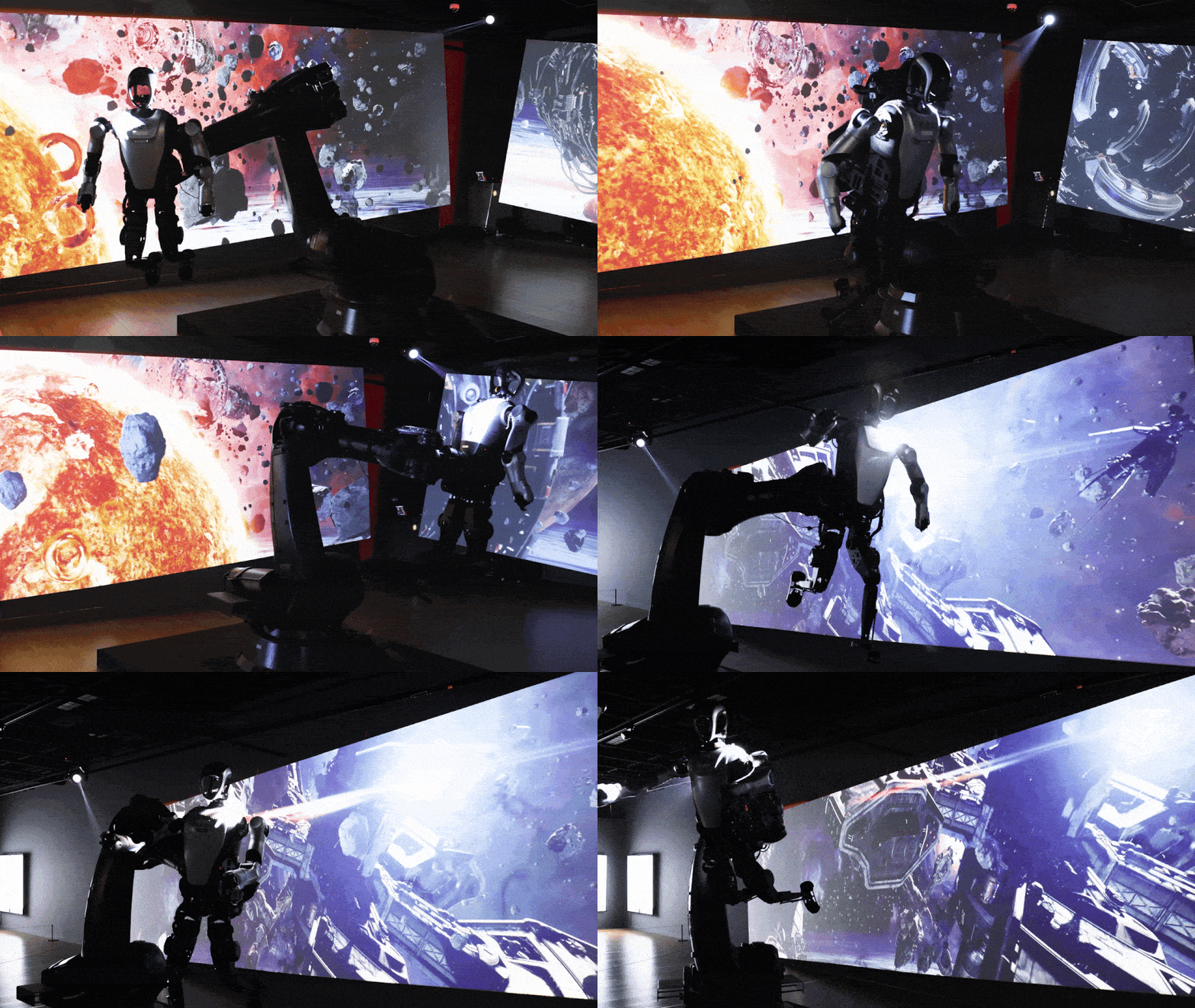
The Installation: Suspended Labor
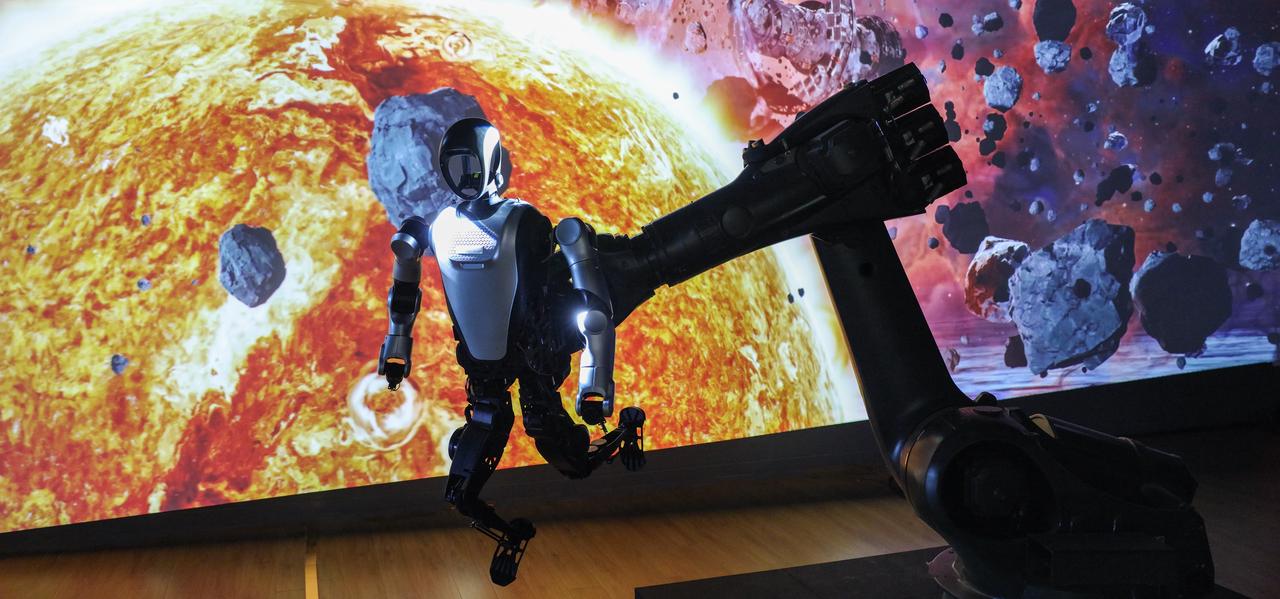
Visually, the work presents a "kinetic umbilical." A massive industrial robotic arm acts as an infrastructure layer, suspending a life-size humanoid robot in mid-air.Using active admittance control, the industrial arm provides buoyancy-like support, canceling gravity to simulate the physics of an extravehicular spacewalk. The humanoid is not a puppet but an agent; it floats in a microgravity drift, oriented not toward the audience, but toward a projection of the "invisual" hazard of space debris.
The System: A Rolling Risk Corridor
The environment is not a pre-rendered loop. It is a live simulation driven by the Continuity Criterion.- Real Data: The system ingests Two-Line Element (TLE) sets from CelesTrak archives, creating a scientifically grounded representation of current orbital pollution.
- The Corridor: Instead of trying to visualize all debris at once, the system calculates a "Rolling Risk Corridor"—a time-windowed set of high-probability collision risks that the robot must address.
- Sedimentation: When the humanoid acts to "clear" a path, the system does not simply play an animation. It records the intervention, the energy expended (motor torque), and the risk reduction.
The Anti-Reset Logic
The defining feature of Stardust Yu Gong is that it refuses to reset.In a standard video game or art installation, restarting the system wipes the slate clean. Here, the system implements sedimentation. Every intervention made during the exhibition is written into a permanent "world-state." When the system reboots or a new operator takes over, the installation "rehydrates" the previous state. The new session inherits the progress, the wear-and-tear, and the data of the previous generation.